

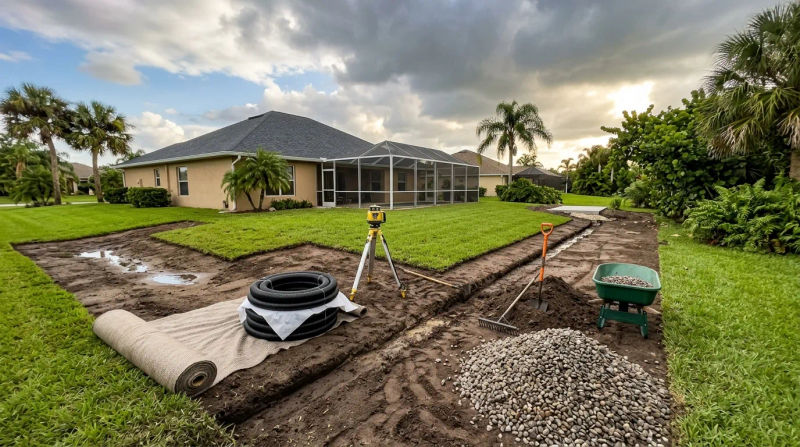
As a specialist who has spent more than 15 years working on homes here in Fort Pierce, I know that standing water in the yard is one of the most common and frustrating problems homeowners face. Especially as we head into June, with the daily downpours and the looming threat of hurricane season, a soggy lawn isn't just an inconvenience - it's a risk to your home's foundation and your peace of mind. Cost is always a top concern, and I've found that homeowners often delay fixing drainage issues because the pricing seems unclear. My goal here is to provide a transparent, straightforward guide to help you understand the real costs of yard drainage solutions and make an informed budget for protecting your property.
Average Costs in Fort Pierce
Here in coastal Florida, we deal with a high water table, sandy soil, and intense rainfall. The right drainage solution has to account for these local factors. While every yard is unique, we can provide some realistic price ranges for common projects based on our experience in St. Lucie County. These figures typically include labor, materials, and standard equipment use.
- Landscape Grading: Often, the simplest solution is the most effective. Re-grading the land to create a gentle slope (a "swale") that directs water away from your home is a foundational step. For a typical suburban lot, the landscape grading cost St Lucie County residents can expect is usually between $1,800 and $4,500. This depends on the amount of soil that needs to be moved and the accessibility of the area for our equipment.
- French Drain Installation: A French drain is a gravel-filled trench containing a perforated pipe that redirects subsurface water. It’s highly effective for chronically saturated areas. The French drain price Fort Pierce FL homeowners see often falls in the range of $45 to $75 per linear foot. A standard 50-foot drain to protect a patio or foundation might cost between $2,250 and $3,750.
- Catch Basin Installation: Catch basins are grated boxes installed at low points in the yard to collect surface water quickly during a downpour. They connect to underground pipes that carry the water away. The catch basin installation cost coastal Florida is typically $700 to $1,300 per basin. The total project cost increases with the number of basins and the length of pipe needed to connect them to a suitable discharge point.
- Comprehensive Systems: For significant water issues, the best solution is often a combination of grading, catch basins, and French drains. A full-yard system designed by our trained crews to handle heavy storm loads can range from $4,000 to $9,000+, providing a robust, long-term fix.
Factors That Affect Price
The price ranges above are a good starting point, but several factors can influence the final yard drainage cost. Understanding these variables will help you see where your money is going.
- Project Scope and Complexity: A simple, 20-foot French drain along a driveway will naturally cost less than a complex system with multiple catch basins, a sump pump, and extensive piping across the entire backyard.
- Site Accessibility: Can our technicians easily get equipment to the work area? Tight spaces, fences, and established gardens can require more manual labor, which increases the time and cost of the project.
- Soil Conditions: While Fort Pierce's sandy soil is generally easier to excavate than heavy clay, it can be unstable. Our organized workflows include properly shoring trenches to ensure safety and prevent collapse, which is a critical part of a professional installation.
- Building Era & Existing Landscape: Many homes in our area, particularly in neighborhoods like Palm Bay, were built in the 1980s. Over 30-40 years, the original grading around these concrete block homes can settle, or subsequent landscaping projects may have inadvertently created dams that trap water against the foundation. Correcting decades of soil settlement requires a careful, experienced approach and can be more involved than working on a newer property.
- The Discharge Point: Where the collected water ultimately goes is a major cost factor. Discharging it to the street or a natural area on your property (known as "daylighting") is the most straightforward option. However, if the system must be tied into a municipal storm sewer, this often requires additional permits, specialized connections, and adherence to local codes, increasing the overall cost and complexity.
How to Get the Best Value
Getting the best value isn't about finding the cheapest price; it's about investing in a solution that works correctly the first time and lasts for years. A failed drainage system is far more expensive in the long run.
- Focus on the Foundation First: If your budget is limited, prioritize the areas where water poses the biggest threat - right next to your house. A well-placed French drain or proper grading around the foundation provides the highest return on investment by preventing costly structural damage.
- Phase the Project: You don't always have to solve every water problem at once. Work with a contractor to develop a multi-phase plan. Address the most critical area this year before hurricane season, and budget for secondary low spots next year.
- Combine with Other Work: If you're already planning to install a new patio, walkway, or extensive landscaping, that is the perfect time to address drainage. The ground will already be disturbed, which can significantly reduce the labor cost associated with excavation.
- Invest in Quality Materials: There's a big difference between cheap, flexible corrugated pipe and rigid, smooth-wall PVC pipe. Our technicians prefer using high-quality, non-woven geotextile fabric and clean drainage gravel because these materials prevent clogging and ensure the system functions effectively for decades.
Questions to Ask Your Contractor
To ensure you're hiring a competent professional, you need to ask the right questions. A good contractor will welcome them and provide clear answers.
- What do you believe is the primary cause of my water problem? Their answer should be a diagnosis of the issue (e.g., negative grade, compacted soil, high water table), not just a sales pitch for a product.
- Can you draw a simple diagram of the proposed solution? This helps you visualize where trenches, pipes, and basins will be located.
- Where will the water be discharged? Have you confirmed this is a legally permissible discharge point?
- What specific materials will you be using for the pipe, fabric, and backfill?
- Will this project require a permit from St. Lucie County or the City of Fort Pierce?
- What does your warranty cover? Does it include workmanship and system performance?
- How will you protect my existing lawn, sprinklers, and landscaping during the work?
Dealing with yard drainage can feel overwhelming, but taking action now is a wise investment in your home's health and value. By understanding the costs and asking the right questions, you can confidently choose a solution that will keep your yard dry and your foundation safe for years to come. For a personalized estimate to understand your specific needs, the team at Patrick Home Repair Maintenance Lawnscaping Service LLC can provide a free consultation.